Employees exposed to temperature extremes may be at risk of hot or cold stress, which can cause significant health hazards. If overexposed, their bodies can quickly be overcome with heat-related or cold-related illnesses. Employees that work outdoors (construction, landscaping, delivery services, etc.) are at particular risk.
Where employees could potentially be exposed to extreme temperatures, as an employer you must ensure that:
While the employer is ultimately responsible for all the provisions mentioned above, the supervisor has a vital role to play in the safety of their teams. As a supervisor, you must:
- Acquaint your employees with the hazards and control measures associated with their work.
- Provide the information and instruction necessary to ensure their health and safety.
- Enforce company safety rules, programs & codes of practice and procedures.
Working in the Heat
During the summer, meteorologists measure the humidex to warn people when temperatures become hazardous. However, the humidex does not take into account the level of activity performed by employees so WorkSafeNB (and some other provinces) require employers to meet the American Conference of Governmental Industrial Hygienists (ACGIH) threshold limit value (TLV for heat stress). The index used by ACGIH is called the Wet Bulb Globe Temperature (WBGT).
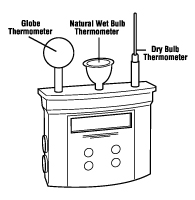
Since measuring WBGT can be challenging for employers, the humidex readings can be used as a guide to limit moderate to heavy work activities to cooler times of the day (early morning or evening) or delay them entirely until the outdoor temperature cools off.
Whether working inside or outside during the hot summer months, it is important that employees listen to their bodies and learn to recognize the five main forms of heat stress and their symptoms:
- Heat rash - "prickly heat rash", tiny, raised blister-like rash on the skin.
- Heat cramps - painful muscle spasms and excessive sweating.
- Heat exhaustion - headache, dizziness, weakness, nausea and clammy skin.
- Heat syncopy - fainting while standing.
- Heat stroke - severe headache, confusion, delirium, convulsions, loss of consciousness and hot, dry, flushed skin.
There are various factors that can influence the onset of heat related symptoms, including:
- Environmental conditions: air temperature, humidity, wind speed and radiant heat (sun).
- Intensity of work/work load.
- Duration of exposure.
- Frequency of work.
- Human factors such as physical fitness, age, medications.
- Type of clothing.
- Degree of acclimatization or becoming accustomed to the work and environmental conditions.
Tips for Preventing Overexposure to Heat and Sun
- Learn to recognize the signs and symptoms of heat stress in yourself and your co-workers.
- Acclimatize your body to working in the heat and sun.
- Drink plenty of water (about two glasses of water before starting work and one cup (250 ml) or more about every 15 to 20 minutes during work) and get adequate nutrition.
- Avoid caffeine, alcohol, and drugs.
- Wear light-coloured, loose-fitting clothing made of breathable fabric.
- Wear a wide-brimmed hat. If a hard hat is required, attach a piece of light-coloured fabric to the back and sides to shade your neck.
- Take rest breaks in a cool or ventilated area. Take more breaks during the hottest part of the day or when doing heavy work. Allow your body to cool down before beginning again.
- Schedule work to minimize heat exposure. Do the hardest physical work during the coolest part of the day.
- Use sunscreen with an SPF of at least 30. You need to apply at least one ounce (29.58 ml) 30 minutes before sun exposure to ensure that you get the full SPF of a sunscreen. Re-apply it every two hours throughout the day. (Skin Cancer Foundation recommendation)
- Wear eyewear that provides UV protection.
Working in the Cold
Cold weather can be a serious hazard. Construction, trucking, farming and logging are examples of occupations where the potential for hypothermia and frostbite exists. There are also safety problems associated with working in cold environments - ice, snow, burns from contact with cold metal, slowed reaction time and snow blindness.
Learn to recognize the warning signs of hypothermia:
- Severe shivering (In severe cases, shivering may stop - seek medical attention immediately).
- Pain in extremities (hands, feet, ears).
- Reduced mental capacity (confusion, difficulty speaking, etc.).
For frostbite, in mild cases, the symptoms include inflammation of the skin in patches accompanied by slight pain. In severe cases, there could be tissue damage without pain, or there could be burning or prickling sensations resulting in blisters.
Tips for Preventing Overexposure to Cold
- Wear proper clothing in layers.
- First layer - snug-fitting and of a material that allows sweat to escape (silk or polypropylene).
- Second layer - loose and warm (fleece, wool or down).
- Third layer - windproof and waterproof (nylon or Gore-Tex).
- Wear mittens when working in temperatures below -17°C, gloves for light work below 4°C and -7°C for moderate work, a warm knit hat or a liner under a hard hat, and footwear that is insulated, slip-resistant and waterproof.
- Take frequent measures of temperature with the wind factor.
- Take warm-up breaks in a shelter.
- Pace work to prevent excessive sweating as the moisture will speed cooling of the body. Add or remove layers as appropriate.
- Stay hydrated. Drink water or warm, sweet beverages (sports-types drinks). Avoid caffeinated drinks.
- Know the signs of hypothermia and frostbite. Use the buddy system to watch for signs shown by your co-workers.