

Legislation
General Regulation - Occupational Health and Safety Act
N.B. Reg. 91-191
Part X CONSTRUCTION, TRAFFIC AND BUILDING SAFETY
Section 121 Fixed Ladders
- 121. (1) An employer shall ensure that a fixed ladder
- (a) is of adequate strength and length,
- (b) is clean and free from grease,
- (c) is maintained in a safe condition,
- (d) is securely held in place at the top and bottom and at such intermediate points as are required to prevent sway,
- (e) has a clearance of at least 165 mm maintained between the rungs and the structure to which the ladder is affixed,
- (f) does not have any rungs that extend above a landing,
- (f.1) is placed in such a way that an adequate landing surface that is clear of obstructions is available at the top and bottom of the ladder for access and egress,
- (g) has side rails or other secure hand holds that extend at least 1.07 m above the landing and are spaced not less than 685 mm apart, and
- (h) is removed from service when it has loose, broken or missing rungs, split side rails or other defects that may be hazardous to an employee.
- (2) An employer shall ensure that a fixed ladder that is more than 6 m in height is equipped with ladder cages.
- (3) Subsection (2) does not apply where an employee on the ladder uses a fall-arresting system.
- (4) Where a ladder cage is used on a fixed ladder, an employer shall ensure that
- (a) the cage is provided with metal hoops spaced to prevent an employee from falling away from the ladder and to contain an employee who may lean or fall against the cage,
- (b) the cage extends not less than 685 mm and not more than 725 mm from the centre line of the rungs of the ladder,
- (c) the cage is not less than 685 mm wide where it attaches to the ladder,
- (d) the cage extends from a point 2.5 m from the base of the ladder to the top of the ladder,
- (e) the inside of the cage is free of projections, and
- (f) if the fixed ladder is more than 9 m in height, it is equipped with a rest platform at intervals of no more than 9 m.
[N.B. Reg. 96-106, s. 6; 2010-159, s. 22; 2024-38, s. 60]
Demolition
Part XI TEMPORARY STRUCTURES
Section 122
- 122. (1) An employer shall ensure that a portable ladder used at a place of employment is
- (a) of adequate strength and length,
- (b) clean and free of grease, and
- (c) maintained in a safe condition.
- (2) An employer shall ensure that a portable ladder is removed from service when it has loose, broken or missing rungs, split side rails or other defects that may be hazardous to the safety of an employee.
[N.B. Reg. 2024-38, s. 62]
Section 123
123. An employer shall ensure that a wooden portable ladder
- (a) is made of No. 1 grade or better spruce or fir,
- (b) is not painted other than by being preserved with a transparent protective coating,
- (c) if a single ladder, does not exceed 6 m in length,
- (d) has rungs
- (i) free of knots,
- (ii) designed to carry a load of 200 kg placed at the centre,
- (iii) uniformly spaced with a maximum rise of 300 mm,
- (iv) secured to each side of the side rail of the ladder by at least three screws or barbed nails of adequate length or by attachments giving equivalent or better strength, and
- (v) notched into the side rails of the ladder at least 13 mm on the lower side or with fillers installed between the rungs, and
- (e) has side rails
- (i) dressed on all sides and without sharp edges, and
- (ii) with a uniform clear width between them of not less than 300 mm for ladders 3 m in length or less, and increasing 1 mm in width for each 100 mm in excess of 3 m.
Section 124 Portable Ladders
- 124. (1) An employer shall ensure that a portable ladder complies with and is used in accordance with either of the following standards:
- (a) CSA standard Z11-12 (R2017), Portable ladders or a standard offering equivalent or better protection; or
- (b) ANSI standard ANSI ASC A-14.7-2011, Safety Requirements for Mobile Ladder Stands and Mobile Ladder Stand Platforms or a standard offering equivalent or better protection.
- (2) An employer shall ensure that a portable extension ladder
- (a) has no more than three sections,
- (b) has locks that securely hold the sections of the ladder in an extended position, and
- (c) when extended, maintains a minimum overlap as follows:
- (i) where the ladder is 11 m or less, the overlap shall be 1 m;
- (ii) where the ladder exceeds 11 m and is 15 m or less, the overlap shall be 1.25 m; and
- (iii) where the ladder exceeds 15 m and is 22 m or less, the overlap shall be 1.5 m.
- (3) An employee working 3 m or more above the ground or floor level on a portable ladder may work without a fall-protection system if
- (a) the work is a light duty task of short duration at each location,
- (b) the employee's centre of gravity is maintained between the two ladder side rails,
- (c) the employee will generally have one hand available to hold on to the ladder or another support, and
- (d) the ladder is not positioned near an edge or floor opening that would significantly increase the potential fall distance.
[N.B. Reg. 2010-159, s. 23; 2024-38, s. 63]
Section 125
- 125. (1) An employee who uses a portable ladder shall
- (a) inspect the ladder before use,
- (b) report any unsafe condition of the ladder to the employer,
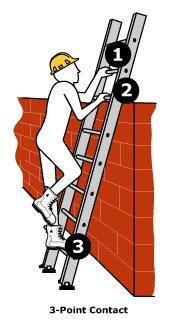
- (c) face the ladder and use both hands when climbing or descending, and
- (d) when standing on a ladder, stand in the centre between the side rails.
- (2) An employee who uses a portable ladder shall ensure that
- (a) the ladder is secured against movement,
- (b) the side rails of the ladder extend at least 1 m above any platform or landing to which the ladder is a means of access, and
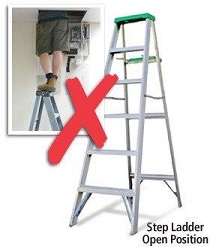
- (c) if a step ladder, the legs are securely held in position by means of metal braces or an equivalent rigid support.
- (3) An employee who uses a portable ladder shall not
- (a) splice ladders together unless the spliced section is braced so that the spliced side rails are as strong as the original side rails,
- (b) place a ladder in front of or against a door unless the door is blocked in the open position, locked or guarded,
- (c) use a ladder as scaffold flooring or as support for scaffold flooring,
- (d) stand on the material shelf, the top or the top step of a portable step ladder, or
- (e) work from the top three rungs of a portable single or extension ladder.
- (4) Paragraphs (1)(d) and (3)(c) and (e) do not apply to a firefighter engaged in structural fire-fighting or rescue.
[N.B. Reg. 97-121, s. 22]
Part XIX ELECTRICAL SAFETY
Section 289 Utility Lines and Utility Line Equipment
- 289. (1) An employer shall ensure that an employee who is not a qualified person does not carry out any work, and no such employee shall carry out any work, that is liable to bring any person or object closer to an energized electrical utility line or utility line equipment than the distances specified in the following table:
| Phase to Phase Voltage of Energized Electrical Utility Line or Utility Line Equipment | Distance |
| Up to 750 v | 900 mm |
| 750 v - 100,000 v | 3.6 m |
| 100,001 v - 250,000 v | 5.2 m |
| 250,001 v - 345,000 v | 6.1 m |
- (2) Where an employee who is not a qualified person is about to commence work that is liable to bring any person or object closer to an energized electrical utility line or utility line equipment than a distance specified in subsection (1), an employer shall contact the authority owning or operating the energized electrical utility line or utility line equipment and shall ensure that the utility line or utility line equipment
- (a) is de-energized, or
- (b) is adequately insulated or guarded
- before permitting the employee to commence the work.
[N.B. Reg. 2001-33, s. 100]