

Legislation
Occupational Health and Safety Act
S.N.B. 1983, c. O-0.2
DUTIES OF EMPLOYERS, OWNERS, CONTRACTORS, SUB-CONTRACTORS, SUPERVISORS, EMPLOYEES AND SUPPLIERS
Section 9 Duties of employer
- 9. (1) Every employer shall
- (a) take every reasonable precaution to ensure the health and safety of its employees;
- (b) comply with this Act, the regulations and any order made in accordance with this Act or the regulations; and
- (c) ensure that its employees comply with this Act, the regulations and any order made in accordance with this Act or the regulations.
- (2) Without limiting the generality of the duties under subsection (1), every employer shall
- (a) ensure that the necessary systems of work, tools, equipment, machines, devices and materials are maintained in good condition and are of minimum risk to health and safety when used as directed by the supplier or in accordance with the directions supplied by the supplier;
- (a.1) ensure that the place of employment is inspected at least once a month to identify any risks to the health and safety of its employees;
- (b) acquaint an employee with any hazard in connection with the use, handling, storage, disposal and transport of any tool, equipment, machine, device or biological, chemical or physical agent;
- (c) provide the information that is necessary to ensure an employee’s health and safety;
- (c.1) provide the instruction that is necessary to ensure an employee’s health and safety;
- (c.2) provide the training that is necessary to ensure an employee’s health and safety;
- (c.3) ensure that work at the place of employment is competently supervised and that supervisors have sufficient knowledge of all of the following with respect to matters that are within the scope of the supervisor’s duties:
- (i) this Act and any regulations under this Act that apply to the place of employment;
- (ii) any safety policy for the place of employment;
- (iii) any health and safety program for the place of employment;
- (iv) any health and safety procedures with respect to hazards in connection with the use, handling, storage, disposal and transport of any tool, equipment, machine, device or biological, chemical or physical agent by employees who work under the supervisor’s supervision and direction;
- (v) any protective equipment required to ensure the health and safety of the employees who work under the supervisor’s supervision and direction; and
- (vi) any other matters that are necessary to ensure the health and safety of the employees who work under the supervisor’s supervision and direction;
- (c.4) ensure that work at the place of employment is sufficiently supervised;
- (d) provide and maintain in good condition such protective equipment as is required by regulation and ensure that such equipment is used by an employee in the course of work;
- (e) co-operate with a committee, where such a committee has been established, a health and safety representative, where such a representative has been elected or designated, and with any person responsible for the enforcement of this Act and the regulations.
- (3) An employer shall develop a program for the inspection referred to in paragraph (2)(a.1) with the joint health and safety committee, if any, or the health and safety representative, if any, and shall share the results of each inspection with the committee or the health and safety representative.
[S.N.B. 2001, c. 35, s. 3; 2007, c. 12, s. 2; 2013, c. 15, s. 4; 2019, c. 38, s. 4; 2022, c. 32, s. 5]
Section 12 Duties of employee
12. Every employee shall
- (a) comply with this Act, the regulations and any order made in accordance with this Act or the regulations;
- (b) conduct themselves to ensure their own health and safety and that of other persons at, in or near the employee’s place of employment;
- (c) report to the employer or supervisor the existence of any hazard of which the employee is aware;
- (d) wear or use such protective equipment as is required by regulation;
- (e) consult and co-operate with the committee where one has been established or with the health and safety representative where one has been elected or designated; and
- (f) co-operate with any person responsible for the enforcement of this Act and the regulations.
[S.N.B. 2001, c. 35, s. 6; 2007, c. 12, s. 3; 2019, c. 38, s. 7; 2022, c. 32, s. 7]
General Regulation - Occupational Health and Safety Act
N.B. Reg. 91-191
Part VII PROTECTIVE EQUIPMENT
Section 38 General
- 38. (1) Where protective equipment is required to be used by an employee under this Regulation, an employer shall ensure that the employee is instructed and trained on how to use, care for and inspect the protective equipment in accordance with the manufacturer’s specifications.
- (2) Where protective equipment is required to be used by an employee under this Regulation, an employee shall
- (a) use the equipment that is required in accordance with the instruction and training received,
- (b) test or visually inspect the equipment before each use as appropriate to the type of equipment to be used,
- (c) report any defective equipment to the employer and not use the equipment, and
- (d) care for the equipment properly while using it.
[N.B. Reg. 2024-38, s. 23]
Section 39
39. Where an employee is exposed to a hazard that may irritate or injure the eyes, face, ears or front of the neck, the employee shall use protective equipment that is appropriate to the hazard and that conforms to CSA standard CAN/CSA-Z94.3-15, "Eye and face protectors" or a standard offering equivalent or better protection.
[N.B. Reg. 2001-33, s. 16; 2020-35, s. 2; 2022-27, s. 20]
Section 40
- 40. (1) On a project site, an employee shall use Class E, Type 2 headwear that conforms to CSA standard CSA Z94.1-15, "Industrial protective headwear - Performance, selection, care and use" or a standard offering equivalent or better protection.
- (2) At a place of employment, other than a project site, where an employee is exposed to a hazard that may injure the employee's head, the employee shall use protective equipment that is appropriate to the hazard and that conforms to CSA standard CSA Z94.1-15 "Industrial protective headwear - Performance, selection, care, and use" or a standard offering equivalent or better protection.
- (3) An employer shall provide the safety headwear referred to in subsections (1) and (2) to employees and shall ensure that the employees wear the headwear.
- (4) The safety headwear shall be equipped with a retention system to secure the safety headwear to the employee’s head when the employee is working in conditions that may cause loss of the headwear.
[N.B. Reg. 2001-33, s. 17; 2020-35, s. 3; S.N.B. 2024, c. 5, s. 2; 2024-38, s. 24]
Section 41
- 41. (1) On a project site, an employee shall use Grade 1 footwear with sole protection that conforms to CSA standard CSA-Z195:14, (R2019) "Protective Footwear" or a standard offering equivalent protection.
- (2) At a place of employment, other than a project site, where an employee is exposed to a hazard that may injure the employee's foot, the employee shall use protective equipment that is appropriate to the hazard and that conforms to CSA standard CSA-Z195:14 (R2019), "Protective Footwear" or a standard offering equivalent protection.
[N.B. Reg. 2001-33, s. 18; 2020-35, s. 4; 2022-79, s. 10]
Section 49 Fall-protection system
- 49. (1) The employer shall provide and the employee shall continually use a fall-protection system when an employee works from
- (a) an unguarded work area that is
- (i) 3 m or more above water or the nearest permanent safe level,
- (ii) above any surface or object that could cause injury to the employee upon contact, or
- (iii) above any open top tank, bin, hopper or vat,
- (b) a work area that is 3 m or more above a permanent safe level and from which a person may fall if the work area tips or fails, or
- (c) a work area where an officer has determined that it is necessary for safety reasons to use a fall-protection system.
- (a) an unguarded work area that is
- (2) If an employee is required to work from a communication or power transmission tower or other similar structure 3 m or more above a permanent safe level, the employer shall provide and the employee shall continually use a fall-protection system when at rest and at the working level.
- (3) If an employee referred to in subsection (2) is ascending or descending a communication or power transmission tower or other similar structure, the employer shall provide and the employee shall continually use a fall-arresting system.
- (4) If an employee is required to work from a wood pole or other similar wood pole structure 3 m or more above a permanent safe level, the employer shall provide and the employee shall continually use
- (a) a fall-arresting system when the employee is ascending, descending or at rest, and
- (b) a work positioning system in addition to the fall-arresting system when the employee is performing work at the working level.
- (5) If it is not practical to use a fall-arresting system and a work positioning system, the employer shall provide and the employee referred to in subsection (4) shall continually use a fall restricting system when ascending or descending and to secure themselves to the wood pole when at rest or at the working level.
- (6) This section does not apply to the following situations:
- (a) if the employee will at all times remain further than 3 m from the unguarded edge of a surface with a slope of 3 in 12 or less;
- (b) where a firefighter is engaged in structural firefighting;
- (c) if an employee is engaged in the installation, maintenance or removal of a fall-protection system and another form of fall-protection is not practical, provided the employee has been fully instructed in work procedures and hazards and in how to protect themselves from falling; or
- (d) if it is not practical to use a fall-protection system where an employee is engaged in the weatherproofing of a roof that has a total area of less than 23 m2 or of a roof of a canopy or walkway that have slopes of 3 in 12 or less, provided the employee has been fully instructed in work procedures and hazards and in how to protect themselves from falling.
[N.B. Reg. 97-121, s. 11; 2010-159, s. 4; 2022-27, s. 21]
Section 49.1
- 49.1(1) An owner of a place of employment, an employer and a contractor shall each ensure that the components of a fall-protection system
- (a) are designed in accordance with good engineering practices,
- (b) are erected, installed, assembled, used, handled, stored, adjusted, maintained, repaired and dismantled in accordance with the manufacturer's specifications, and
- (c) meet the requirements of the applicable standards.
- (2) For the purposes of paragraph (1)(c), the following CSA standards apply:
- (a) Z259.1-05 , "Body Belts and Saddles for Work Positioning and Travel Restraint" or Z259.1-95 , "Safety Belts and Lanyards";
- (b) Z259.2.4:15 (R2020), "Fall arresters and vertical rigid rails" , or a standard offering equivalent or better protection;
- (b.1) Z259.2.5-17, "Fall arresters and vertical lifelines" , or a standard offering equivalent or better protection;
- (c) Z259.2.2-17 (R2022), "Self-retracting devices" , or a standard offering equivalent or better protection;
- (d) Z259.2.3-99 , "Descent Control Devices", or a standard offering equivalent or better protection;
- (e) Z259.10-18, "Full body harnesses" , or a standard offering equivalent or better protection;
- (f) Z259.11-17, "Personal energy absorbers and lanyards" , or a standard offering equivalent or better protection;
- (g) Z259.12-16 (R2021), "Connecting components for personal fall-arrest systems (PFAS)" , or a standard offering equivalent or better protection;
- (h) Z259.14-01 , "Fall Restricting Equipment for Wood Pole Climbing", or a standard offering equivalent or better protection;
- (i) Z259.13-04 , "Flexible Horizontal Life Line Systems";
- (i.1) Z259.15-12 (R2016), Anchorage connector , or a standard offering equivalent or better protection; and
[N.B. Reg. 2010-159, s. 5; 2022-76, s. 1; 2024-38, s. 31]
Section 49.2
- 49.2 (1) An owner of a place of employment, an employer and a contractor shall each ensure that any fall-arresting system consists of the following:
- (a) a full body harness that is designed and rated by the manufacturer for the employee's body type and adjusted to fit the employee;
- (b) a self-retracting lanyard, an energy absorbing lanyard or a lanyard and energy absorber that is rated by the manufacturer for the employee;
- (c) unless it is a horizontal life line, an anchor point that is capable of withstanding a 22 kN force or, if used under the direction of a competent person, four times the maximum load that may be generated in the fall-arresting system.
- (2) An owner of a place of employment, an employer and a contractor shall each ensure that a fall-arresting system limits
- (a) free falls to the shortest distance possible, which distance cannot exceed 1.8 m or a shock level on the body of 8 kN, and
- (b) the total fall distance to an amount less than the distance from the work area to any safe level, water or obstruction below.
- (3) Despite subsection (2), if using an energy absorber is hazardous or not practical, the fall-arresting system shall
- (a) not include an energy absorber,
- (b) not use lanyards made of wire rope or other in-elastic material, and
- (c) limit free falls to 1.2 m.
- (4) Before any use of a fall-arresting system by an employee, an owner of a place of employment, an employer or a contractor shall develop a procedure to be used for rescuing an employee in an emergency.
- (5) An owner of a place of employment, an employer and a contractor shall each ensure that an employee is trained to use the procedures referred to in subsection (4) for rescuing another employee in an emergency.
- (6) If a fall-arresting system arrests a fall, an owner of a place of employment, an employer and a contractor shall each ensure that all components, including connecting components of a fall-arresting system are
- (a) removed from service and inspected by a competent person,
- (b) repaired to the designer's or manufacturer's specifications, or
- (c) destroyed when a defect is observed.
[N.B. Reg. 2010-159, s. 5; 2022-27, s. 22]
Section 49.3
- 49.3 (1) An owner of a place of employment who permits the use of a fall-arresting system shall provide or ensure the use of a permanent or temporary anchor point that meets the requirements of paragraph 49.2(1)(c).
- (2) If a permanent anchor point has been provided, an owner of a place of employment shall
- (a) prepare sketches showing the anchor point,
- (b) provide a copy of the sketches to the employee who is using anchor points before the work begins, and
- (c) ensure a copy of the sketches are posted conspicuously near the entrance to the roof.
- (3) An owner of a place of employment shall ensure that every anchor point is inspected and certified by a competent person
- (a) before being used for the first time,
- (b) as recommended by the manufacturer, the installer or an engineer and at least every 12 months,
- (c) after any event or maintenance and repairs, and
- (d) when the owner of a place of employment is informed under subsection (4) of a defect or inadequacy.
- (4) An employer or employee shall inform the owner of a place of employment immediately if they believe that any component of the anchor point is defective or inadequate.
- (5) If the inspection under subsection (3) reveals a defect or inadequacy, no one shall use the anchor point and no owner of a place of employment, employer or contractor shall permit its use until the defect or inadequacy has been eliminated.
[N.B. Reg. 2010-159, s. 5]
Section 49.4
- 49.4 (1) A vertical life line in a fall-arresting system shall
- (a) extend to a safe level,
- (b) be adequately secured or weighted at the base of the life line to prevent tangling or disturbance of the life line,
- (c) be securely attached to an anchor point,
- (d) be free of imperfections,
- (e) be free of knots or splices, except for those that are necessary to connect the life line to an anchor point,
- (f) be provided with protective devices at all sharp edges or corners to protect against cuts to or chafing of the life line, and
- (g) be clearly identified as a life line by colour or other means.
- (2) A vertical life line in a fall-arresting system shall be used for its intended purpose only and shall be used by one employee at a time.
[N.B. Reg. 2010-159, s. 5
Section 49.5
- 49.5 (1) In this section "maximum arrest force" means the peak force exerted on an employee when a fall-arresting system stops a fall.
- (2) When a horizontal life line system which is engineered to meet CSA standard Z259.16-04 , "Design of Active Fall-Protection Systems" is used, an owner of a place of employment, an employer and a contractor shall each ensure
- (a) signed and dated drawings and instructions for the life line are readily available at the place of employment, and
- (b) that the system has been installed in accordance with the design documents.
- (3) The drawings and instructions referred to in paragraph (2)(a) shall contain the following information:
- (a) the layout in plan and elevation, including anchor point locations, strengths, installation specifications, anchor point design and detailing; and
- (b) the specification of the horizontal life line system, including permissible free fall, the maximum arrest force, clearance to obstructions below, cable size, breaking strength, termination details, initial sag or tension, number of permitted employees, and inspection requirements.
[N.B. Reg. 2010-159, s. 5; 2022-27, s. 23]
Section 49.6
49.6 An owner of a place of employment, an employer and a contractor shall each ensure that a competent person installs a pre-engineered horizontal life line system in accordance with the manufacturer's specifications.
[N.B. Reg. 2010-159, s. 5]
Section 49.7
- 49.7 (1) When a horizontal life line system is used which is neither designed nor certified by an engineer and is not a pre-engineered system, an owner of a place of employment, an employer and a contractor shall each ensure it meets the following requirements:
- (a) the wire rope must have a diameter of a minimum of 13 mm with a breaking strength specified by the manufacturer of at least 89 kN;
- (b) connecting hardware such as shackles and turnbuckles must have an ultimate load capacity of at least 71 kN;
- (c) end anchor points shall have a load capacity of at least 71 kN;
- (d) the horizontal life line must be free of splices except at the termination;
- (e) the span of the horizontal life line must be at least 6 m and not more than 18 m;
- (f) the horizontal life line must have an unloaded sag no greater than 1 in 60;
- (g) limit free falls to 1.2 m; and
- (h) a minimum of 5.5 m of unobstructed clearance must be available below the horizontal life line.
- (2) When a horizontal life line system referred to in subsection (1) is used, no more than three employees may be secured to the horizontal life line and the horizontal life line must be positioned so it does not impede the safe movement of employees.
[N.B. Reg. 2010-159, s. 5]
Section 49.8
- 49.8 (1) A personal safety net must meet the following requirements:
- (a) be installed and maintained so that the maximum deflection when arresting the fall of an employee does not allow the employee to come into contact with another surface,
- (b) be connected to any other safety net by splice joints that are equal or greater in strength to the strength of the nets, and
- (c) be installed so as to render it impossible for an employee to come into contact with another surface during a fall between the work area and the safety net.
- (2) An owner of a place of employment, an employer and a contractor shall each ensure that a safety net is designed, selected, installed, used, stored, tested and maintained in accordance with ANSI standard A10.11-1989, "Personnel and Debris Nets".
[N.B. Reg. 2010-159, s. 5]
Section 50
- 50. (1) An owner of a place of employment, an employer and a contractor shall each ensure that employees use fall-protection systems in following order of precedence:
- (a) a guardrail, a travel restraint system or a fall restricting system; or
- (b) a fall-arresting system.
- (2) Despite subsection (1), the use of a guardrail is not permitted on a surface that has a slope exceeding 6 in 12.
- (3) Despite subsection (1), where a fall-protection system is not practical an owner of a place of employment, an employer and a contractor shall each ensure an employee uses a control zone.
- (4) Despite subsection (3), use of a control zone is not permitted on a working surface where the slope of the surface exceeds 3 in 12 or for scaffolds.
- (5) This section does not apply where a firefighter is engaged in structural fire-fighting or rescue.
[N.B. Reg. 97-121, s. 12; 2010-159, s. 6; 2022-27, s. 24]
Section 50.1
50.1 Before an employee is allowed into an area where a risk of falling exists, an employer and a contractor shall each ensure the employee is instructed in the fall-protection system for the area and in the post-fall rescue procedure, if applicable, and that the employee is competent in the procedures to be followed.
[N.B. Reg. 2010-159, s. 7]
Section 50.2
- 50.2 (1) An employer and a contractor shall each ensure that a fall-protection code of practice is written for a place of employment if a fall-protection system is required for the place of employment and
- (a) the employees are working from a height of 7.5 m or more,
- (a.1) the employees are performing rope access work other than rope access work for emergency rescue purposes,
- (b) the employer uses a safety monitor and work procedures when weatherproofing as the means of fall-protection, or
- (c) an officer requires that the code of practice be written.
- (2) The code of practice must be readily available at the place of employment before work begins and employees must have received instruction with regards to the code of practice.
- (3) The code of practice shall be developed in consultation with the committee or the health and safety representative, if any, or with the affected employees.
- (4) The code of practice shall include the following information:
- (a) possible hazardous situations, including a description of the hazards and the possible effects on the health or safety of employees;
- (b) the identification of employees at risk;
- (c) the location where the code of practice might apply;
- (d) the methods and equipment to be used including inspections procedures;
- (e) the procedures and equipment which might be required in the event of an emergency;
- (f) the times, days, or events during which the code of practice might be applicable;
- (g) the identification of training needs;
- (h) the identification of the person responsible for implementing the code of practice; and
- (i) the name of the safety monitor, if applicable, and the training the safety monitor has received.
[N.B. Reg. 2010-159, s. 7; 2022-27, s. 25; 2024-38, s. 32]
Section 50.3
- 50.3 (1) An employer shall ensure that a competent person trains an employee in the use, maintenance and inspection of a fall-protection system for the task being performed unless the fall-protection system is a guardrail.
- (2) The employer shall ensure that the competent person referred to in subsection (1), who provides the training, prepares a written training record which shall include the following information:
- (a) the name of the employee who received the training;
- (b) the date on which the training took place; and
- (c) the name of the competent person and the name of the agency if any.
- (3) The training record for each employee shall be made available to an officer upon request.
- (4) An employer shall, in consultation with the committee or health and safety representative, if any, review annually or more frequently, if required by a change in work conditions or in the fall protection field, the training provided to employees concerning fall protection to determine if retraining is necessary.
[N.B. Reg. 2010-159, s. 7; 2022-27, s. 26]
Section 50.4
- 50.4 (1) An owner of a place of employment, an employer and a contractor shall each ensure that each component of a fall-protection system is inspected as follows to determine whether there are any defective or inadequate components:
- (a) visually by the employee before use during a shift; and
- (b) by a competent person before initial use and periodically as recommended by the manufacturer, installer or an engineer.
- (2) If the inspection reveals a defect or inadequacy, no one shall use the fall-protection system and no owner of a place of employment, employer or contractor shall permit its use until the defect or inadequacy has been eliminated.
- (3) An owner of a place of employment, an employer and a contractor shall each ensure that all components of a fall-protection system are compatible with one another, the work environment and the type of work being done.
[N.B. Reg. 2010-159, s. 7]
Part X CONSTRUCTION, TRAFFIC AND BUILDING SAFETY
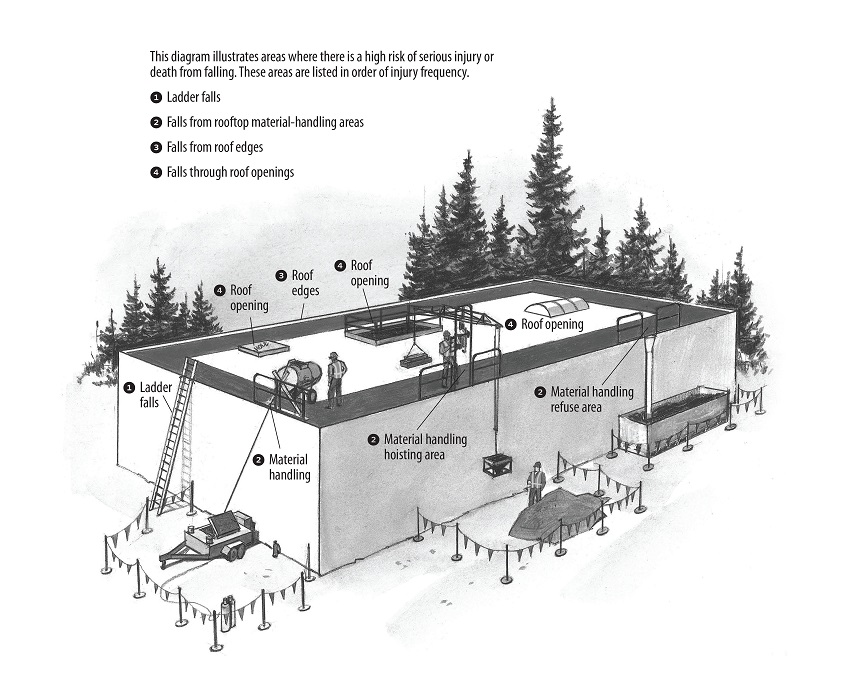
Section 105 Roofs
- 105. (1) An employer and a contractor shall each ensure that a warning line is
- (a) not less than 2 m from the unguarded edge,
- (b) has a minimum diameter of 10 mm,
- (c) is suspended at a height of not less than 750 mm and not more than 900 mm,
- (d) is supported by corner and intermediate posts sufficient to keep the line taut, and
- (e) has readily visible markers placed every 1.5 m along the length of the line.
- (2) Despite paragraph (1)(a), a warning line may be 1 m from an unguarded edge at the dump point for snow removal or when an employee is engaged in weatherproofing, provided adequate precautions are taken to ensure the safety of the employee.
- (3) An employer shall ensure that an employee who is working in the control zone uses another method of fall-protection in addition to the warning line.
- (4) When employees are engaged in weatherproofing, a safety monitor may be used as the means of fall-protection for employees working in the control zone.
- (5) The safety monitor referred to in subsection (4) shall ensure that tasks being performed in the control zone are performed in accordance with the fall-protection code of practice and in a manner that minimizes the potential for an employee to fall.
- (6) A safety monitor referred in subsection (4) shall
- (a) be experienced in the work overseen and trained in the role of safety monitor,
- (b) be present at all times when an employee is in the control zone,
- (c) have complete authority over the work as it relates to the prevention of falls,
- (d) be located so as to have a clear view of the work being performed by the employee,
- (e) be able to communicate with the employees being protected without needing to yell,
- (f) be instantly distinguishable from other workers,
- (g) engage in no other duties while acting as the safety monitor, and
- (h) monitor a maximum of eight workers.
- (7) An employer shall ensure that no employee enters the control zone unless the employee is required to do so by reason of the employee's work duties.
- (8) The owner of a place of employment, employer and contractor shall each ensure a travel restraint system
- (a) is rigged to prevent the employee from reaching an unguarded edge,
- (b) is, subject to paragraph (c), attached to an anchor point capable of supporting two times the maximum load likely to be applied to it, or
- (c) when it is used on a roof with a slope greater than 3 in 12, is attached to an anchor point that is capable of withstanding a 22 kN force or, if used under the direction of a competent person, four times the maximum load that may be generated in the fall-arresting system.
[N.B. Reg. 96-60, s. 1; 2010-159, s. 18]
Section 106
106. An employer shall ensure that an employee who is engaged in the weatherproofing of a roof that
- (a) is 3 m or more above the ground or other safe working level,
- (b) has a slope exceeding 3 in 12, and
- (c) has an unguarded edge,
uses an individual fall-arresting system and the employee shall use the individual fall-arresting system.
[N.B. Reg. 96-60, s. 2; 2024, c. 5, s. 2]
Section 109 Hoisting apparatus used to raise materials to roof
- 109. (1) Repealed. [N.B. Reg. 2022-79, s. 16]
- (2) An employer shall ensure that the weights used to counterbalance a hoisting apparatus used to raise materials to a roof are
- (a) adequate for the equipment used, and
- (b) secured to the hoisting apparatus to prevent their premature removal.
[N.B. Reg. 2022-79, ss. 16, 17]
Section 110 Hoisting apparatus used to raise materials to roof
110. An employer shall ensure that guardrails, or a safety fence manufactured as part of a hoisting apparatus, are installed in perimeter travel areas on a roof near the hoist areas and the dumping areas.
[N.B. Reg. 96-60, s. 6; 2022-79, ss. 18, 19]