

Legislation
General Regulation - Occupational Health and Safety Act
N.B. Reg. 91-191
Part X CONSTRUCTION, TRAFFIC AND BUILDING SAFETY
Section 97 Guardrails
- 97. (1) A guardrail shall
- (a) be made of one of the following materials:
- (i) if made of wood,
- (A) the top rail, vertical supporting posts and intermediate rail shall be constructed of at least 50 mm × 100 mm No. 2 grade or better SPF, these measures being nominal, and
- (B) shall not be painted other than by a transparent protective coating,
- (ii) if made of metal pipe,
- (A) the top rail and vertical supporting posts shall be at least 40 mm in diameter, and
- (B) the intermediate rail shall be at least 25 mm diameter,
- (iii) if made of angle iron,
- (A) the top rail and vertical supporting posts shall be at least 40 mm × 40 mm by 5 mm, and
- (B) the intermediate rail shall be at least 32 mm × 32 mm × 3 mm, or
- (iv) if made of wire rope,
- (A) the vertical supporting posts shall be made of steel of at least 40 mm in diameter or of a material of equivalent strength, and
- (B) the top rail and intermediate rail shall be at least 10 mm in diameter, be attached to a welded fastening on the vertical supporting posts with metal clips to prevent unnecessary sagging and be easily distinguishable from the background; or
- (i) if made of wood,
- (b) be pre-engineered.
- (a) be made of one of the following materials:
- (2) A guardrail shall
- (a) have a height of not less than 900 mm or more than 1.07 m from the floor level,
- (b) have a toeboard which
- (i) is at least 127 mm high,
- (ii) is fastened to the inside of the vertical supporting posts, and
- (iii) has a space of not more than 6 mm between the bottom of the toeboard and the floor,
- (c) have vertical supporting posts not more than 2.4 m apart along its entire length unless otherwise specified in manufacturer's specifications, and
- (d) have vertical supporting posts not more than 3 m apart along its entire length if the guardrail is used on scaffolding.
- (3) The vertical supporting posts referred to in paragraphs 2(c) and (d) shall be adequately fastened to the structure to support the loads imposed upon it.
- (4) Unless the guardrail is a pre-engineered guardrail, the top rail shall be fastened to the top or inside of the vertical supporting posts and the intermediate rail shall be fastened to the inside of the vertical supporting posts midway between the top rail and the floor level.
- (5) A guardrail shall be made of materials with sufficient strength and rigidity to support loads with the following minimums:
- (a) 675 N in any direction, at any point along the top rail;
- (b) 450 N in any direction, at any point along the intermediate rail; and
- (c) 900 N in any direction, at any point along the top rail, intermediate rail and toeboard if the guardrail is used on a surface that is sloped more than 3 in 12 and less than 6 in 12.
[N.B. Reg. 2001-33, s. 33; 2010-159, s. 14]
98. Repealed. [N.B. Reg. 2010-159, s. 15]
Section 100
- 100. (1) Where a guardrail is removed in order for work to be done, an employer and a contractor shall each ensure that
- (a) adequate precautions are taken to ensure the safety of the employee doing the work and any other employee, and
- (b) the area is not left unguarded.
- (2) An employee who removes a guardrail in order to do work shall replace the guardrail before leaving the area.
Part XI TEMPORARY STRUCTURES
Section 131 General Provisions Applicable to Scaffolds
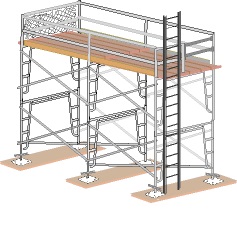
- 131. (1) An employer and a contractor shall each ensure that a scaffold
- (a) is capable of sustaining a minimum uniformly distributed load of 1.4 kPa,
- (b) is at no time subjected to a load that exceeds the equivalent of one-quarter of the load for which it is designed,
- (c) is designed and constructed to support at least four times the load that may be imposed on it,
- (d) if 3 m or more in height, has a guardrail that meets the requirements of section 97,
- (e) is erected plumb and level,
- (f) has vertical supports resting upon a firm foundation or sills,
- (g) is adequately secured at vertical intervals not exceeding three times the least lateral dimension of the scaffold, measured at the base, to prevent lateral movement,
- (h) if sawn lumber planks are used as a platform, has a platform that is at least 500 mm wide, and
- (i) if using manufactured scaffold planks, has a platform that is at least 450 mm wide.
- (2) Paragraph (1)(d) does not apply to a mobile rolling scaffold.
- (3) Subject to subsection (4), an employer shall ensure that the spacing of vertical supports and bearers of a scaffold does not exceed 3 m on centres.
- (4) Where a scaffold is to be used for bricklaying, masonry or other heavy work, an employer shall ensure that the spacing of vertical supports and bearers of a scaffold does not exceed 2.1 m on centres.
[N.B. Reg. 2001-33, ss. 42, 43; 2010-159, s. 27; 2024-38, s. 68]
Section 131.1 Scaffolds - employee requirements
131.1 An employee who uses a scaffold shall
- (a) visually inspect the scaffold before each use, and
- (b) report to the employer any situation or condition that may make the scaffold unsafe to use and, if nec‐ essary, not use the scaffold.
[N.B. Reg. 2024-38, s. 69]
Section 132 Sawn lumber planks
132. An employer and a contractor shall each ensure that a sawn lumber plank in a scaffold
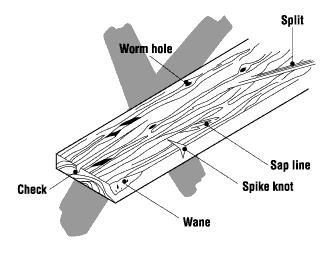
- (a) is at least 50 mm thick by 250 mm wide rough sawn lumber,
- (a.1) is made of No. 2 grade or better spruce, pine or fir,
- (a.2) is not painted other than by being preserved with a transparent protective coating,
- (a.3) is inspected by a competent person before each use to determine the integrity of the plank,
- (b) has a span not longer than 3 m,
- (c) extends at least 150 mm and not more than 300 mm beyond a supporting member,
- (d) is laid flat with an overlap of 300 mm with another plank, with the centre of the overlap directly over a bearer, and
- (e) is secured to prevent movement in any direction that may create a danger to an employee.
[N.B. Reg. 2024-38, ss. 70, 71]
Section 133
- 133. (1) An employer shall ensure that
- (a) lean-to scaffolds on wall brackets are not used,
- (b) the inner supports of the supporting members on a single pole scaffold are of adequate construction and securely fastened to a wall,
- (c) a safe means of access is provided to all working levels of a scaffold, and
- (d) no person uses cross-bracing or diagonal bracing on a scaffold for climbing.
- (2) Where an employee is working on a scaffold above another employee, the employee working above shall ensure that the employee below is protected from the hazard of objects falling from the higher level by overhead protection or by such means as tying off tools and other unsecured objects on the higher level.
Section 134
134. An employee who works on a scaffold and an employer shall each ensure that
- (a) only materials for current use are kept on the scaffold,
- (b) the scaffold is not moved with employees or unsecured tools, materials or equipment on the scaffold, and
- (c) a diagonal supporting brace is removed at the working face level only for access and only if precautions are taken to ensure that the strength of the scaffold is not weakened and the brace is replaced after the work is completed.
Section 135 Wood Scaffolds
- 135. (1) An employer shall ensure that the wooden vertical supports of a wood scaffold
- (a) when 6 m or less in height, are not less than 50 mm thick by 100 mm wide, and
- (b) when greater than 6 m in height, are not less than
- (i) 100 mm thick by 100 mm wide, or
- (ii) two 50 mm thick by 125 mm wide pieces laminated together.
- (2) An employer shall ensure that single wooden vertical supports of a wood scaffold are extended by means of a butt joint that has been strengthened by four pieces of material at least 25 mm thick and of the same width as the vertical supports and extending at least 740 mm on both sides of the butt joint.
- (3) An employer shall ensure that the distance between the joints of laminated vertical supports of a wood scaffold is not less than 1.2 m.
- (4) An employer shall ensure that the minimum size of a bearer on a wood scaffold is 50 mm thick by 125 mm wide.
[N.B. Reg. 2001-33, s. 44]
Section 136 Metal Scaffolds
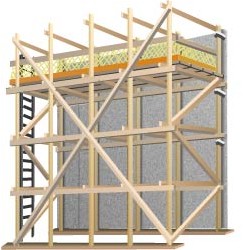
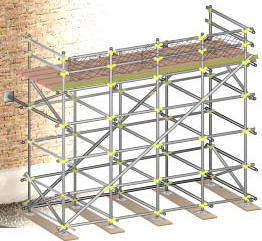
- 136. (1) An employer shall ensure that a metal scaffold
- (a) is erected, used, maintained and dismantled in accordance with the manufacturer's specifications,
- (b) if less than 6 m in height, is equipped with a continuous access ladder or stairway commencing at ground level, and
- (c) if 6 m or greater in height, is equipped with a continuous access stairway commencing at ground level or, if the circumstances do not permit for the metal scaffold to be equipped with a continuous access stairway, with a continuous access ladder commencing at ground level.
- (2) An employer shall ensure that
- (a) a metal scaffold is regularly inspected for any damage, deterioration or loosening of the connections of its structural members that may affect its strength and if such damage, deterioration or loosening is found, that the scaffold is removed from use until repaired,
- (b) cross-bracing and diagonal bracing is installed at each level of a metal scaffold as the erection of the scaffold progresses, and
- (c) no person works on a metal scaffold before the cross-bracing and diagonal bracing is in place, except to erect the scaffold.
[N.B. Reg. 2001-33, ss. 45, 46; 2024-38, s. 73]
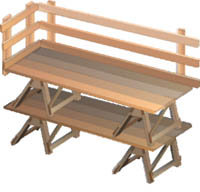
Section 137 Horse Scaffolds
- 137. (1) Where the horses for a horse scaffold are constructed of wood, an employer shall ensure that
- (a) the horizontal members of bearers are not smaller than 50 mm thick by 125 mm wide,
- (b) the legs are not smaller than 50 mm thick by 100 mm wide,
- (c) the longitudinal braces between legs are not smaller than 25 mm thick by 150 mm wide,
- (d) the gusset braces at the top of the legs are not smaller than 25 mm thick by 200 mm wide, and
- (e) the half diagonal braces are not smaller than 25 mm thick by 100 mm wide.
- (2) An employer shall ensure that the horses for a horse scaffold are
- (a) placed on a secure footing and not raised in height by blocking or extensions,
- (b) spaced not more than
- (i) 1.5 m apart for a scaffold supporting 3.6 kPa or more,
- (ii) 2.3 m apart for a scaffold supporting 1.2 kPa to 3.5 kPa, and
- (iii) 3 m apart for a scaffold supporting less than 1.2 kPa, and
- (c) placed directly over one another and, if more than two tiers high, each tier is secured to a building or structure.
- (3) An employer shall ensure that a platform of a horse scaffold
- (a) if supported by single tier horses, does not exceed 5 m in height,
- (b) if supported by tiered horses, does not exceed three tiers or 3.7 m in height, whichever is the lower, and
- (c) is secured to the legs of the horses to prevent movement.
[N.B. Reg. 2001-33, s. 47]
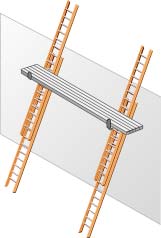
Section 138 Ladderjack Scaffolds
- 138. (1) An employer shall ensure that a ladder-jack scaffold
- (a) is not more than 5 m in height,
- (b) has supporting ladders properly secured against displacement,
- (c) is used only for operations where the work period between changes of scaffold position is of short duration and the load on the scaffold does not exceed 1.2 kPa, and
- (d) is not used by more than two employees at any one time.
- (2) An employer shall ensure that a ladder-jack assembly is securely fastened to the ladder so that it bears on the side rails.
- (3) Where a manufactured platform is used on a ladder-jack scaffold, an employer shall ensure that the platform is a minimum of 500 mm in width and is supported at intervals not exceeding 3 m.
[N.B. Reg. 2001-33, ss. 48, 49]
Section 139 Pump-jack Scaffolds
139. An employer shall ensure that a pump-jack scaffold
- (a) if made of metal, is not more than 15 m in height and is erected, installed and used according to the manufacturer's specifications, and
- (b) if made of wood, is not more than 9 m in height.
[N.B. Reg. 2001-33, s. 50]
Section 140 Mobile Rolling Scaffolds
- 140. (1) An employer shall ensure that a mobile rolling scaffold
- (a) is not higher than four times the width of the smallest base dimension, unless it is guyed or otherwise secured at the top,
- (b) has diagonal and horizontal cross-bracing installed at every level,
- (c) has a solid platform covering the entire area from which an employee works,
- (d) has lockable wheels that are locked while the mobile rolling scaffold is in use, and
- (e) has guardrails.
- (2) Where a mobile rolling scaffold is equipped with pneumatic tires, an employer and any person who uses the scaffold shall each ensure that the wheels are blocked separately in such a way as to raise the wheels off the ground or floor before the scaffold is used.
- (3) An employer and any person who uses a mobile rolling scaffold shall each ensure that the scaffold is not used until inspected before each day's use by a competent person and by the person who is to use the scaffold.
[N.B. Reg. 2001-33, s. 51; 2024-38, s. 74]
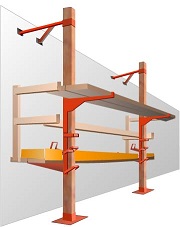
Bracket scaffolds
Section 140.01 Bracket scaffold
- 140.01 (1) An employer shall ensure that the metal brackets of a bracket scaffold are not more than 3 m apart and are securely attached to prevent the brackets from dislodging.
- (2) An employer shall ensure that a bracket scaffold is erected, installed, assembled, used, stored, serviced, tested, cleaned, adjusted, maintained, repaired, inspected and dismantled in accordance with the manufacturer’s specifications or, if the scaffold is designed by an engineer, in accordance with the design.
[N.B. Reg. 2024-38, s. 75]
Part XIX ELECTRICAL SAFETY
Section 289 Utility Lines and Utility Line Equipment
- 289. (1) An employer shall ensure that an employee who is not a qualified person does not carry out any work, and no such employee shall carry out any work, that is liable to bring any person or object closer to an energized electrical utility line or utility line equipment than the distances specified in the following table:
| Phase to Phase Voltage of Energized Electrical Utility Line or Utility Line Equipment | Distance |
| Up to 750 v | 900 mm |
| 750 v - 100,000 v | 3.6 m |
| 100,001 v - 250,000 v | 5.2 m |
| 250,001 v - 345,000 v | 6.1 m |
- (2) Where an employee who is not a qualified person is about to commence work that is liable to bring any person or object closer to an energized electrical utility line or utility line equipment than a distance specified in subsection (1), an employer shall contact the authority owning or operating the energized electrical utility line or utility line equipment and shall ensure that the utility line or utility line equipment
- (a) is de-energized, or
- (b) is adequately insulated or guarded
- before permitting the employee to commence the work.
[N.B. Reg. 2001-33, s. 100]