

Legislation
General Regulation - Occupational Health and Safety Act
N.B. Reg. 91-191
Part V NOISE AND VIBRATION
Section 32 Hearing protective equipment
32. Where necessary, an employer shall provide, and an employee shall use, adequate hearing protective equipment so that the exposure of an employee to noise is kept within the limits prescribed by section 30.
Part VII PROTECTIVE EQUIPMENT
Section 39
39. Where an employee is exposed to a hazard that may irritate or injure the eyes, face, ears or front of the neck, the employee shall use protective equipment that is appropriate to the hazard and that conforms to CSA standard CAN/CSA-Z94.3-15, "Eye and face protectors" or a standard offering equivalent or better protection.
[N.B. Reg. 2001-33, s. 16; 2020-35, s. 2; 2022-27, s. 20]
Section 40
- 40. (1) On a project site, an employee shall use Class E, Type 2 headwear that conforms to CSA standard CSA Z94.1-15, "Industrial protective headwear - Performance, selection, care and use" or a standard offering equivalent or better protection.
- (2) At a place of employment, other than a project site, where an employee is exposed to a hazard that may injure the employee's head, the employee shall use protective equipment that is appropriate to the hazard and that conforms to CSA standard CSA Z94.1-15 "Industrial protective headwear - Performance, selection, care, and use" or a standard offering equivalent or better protection.
- (3) An employer shall provide the safety headwear referred to in subsections (1) and (2) to employees and shall ensure that the employees wear the headwear.
- (4) The safety headwear shall be equipped with a retention system to secure the safety headwear to the employee’s head when the employee is working in conditions that may cause loss of the headwear.
[N.B. Reg. 2001-33, s. 17; 2020-35, s. 3; S.N.B. 2024, c. 5, s. 2; 2024-38, s. 24]
Section 42
42. Where an employee is exposed to a hazard that may injure the skin, the employee shall use, as necessary,
- (a) adequate protective gloves,
- (b) adequate protective footwear,
- (c) adequate body covering,
- (d) Repealed. [N.B. Reg. 2024-38, s. 25]
- (e) a barrier cream or oil to prevent irritation to exposed parts of the body, or
- (f) other protective equipment sufficient to provide protection from the hazard.
[N.B. Reg. 2024-38, s. 25]
Section 48 Hearing Protective Equipment
- 48. (1) An employer shall ensure that hearing protective equipment conforms to CSA standard Z94.2-14 (R2019), Hearing protection devices - Performance, selection, care, and use or a standard offering equivalent protection.
- (2) An employer shall consult with a committee or health and safety representative, if any, or with employees if there is no committee or representative, concerning the selection of the types of hearing protective equipment to be used by employees.
- (3) Where hearing protective equipment is required, an employer and an employee who uses the equipment shall each ensure that the equipment is kept in a sanitary condition.
[N.B. Reg. 2001-33, s. 21; 2020-35, s. 7; 2022-79, s. 12; 2024-38, s. 30]
Part IX TOOLS
Section 86
- 86. (1) An employee who uses a chain saw, brush saw or clearing saw other than in a logging operation, silviculture operation or arboricultural operation shall comply with the requirements of sections 347, 349, 350 and 352.
- (1.1) Notwithstanding subsection (1), a firefighter engaged in structural fire-fighting or rescue is exempt from the requirements of section 347 and paragraphs 349(a), (e), (h) and (i).
- (2) Where an employee uses a chain saw, brush saw or clearing saw other than in a logging operation, silviculture operation or arboricultural operation, the employer shall comply with the requirements of sections 346 and 351.
- (2.1) Notwithstanding subsection (2), where a firefighter is engaged in structural fire-fighting or rescue, the employer is exempt from the requirements of section 346.
- (3) An owner of a chain saw used other than in a logging operation, silviculture operation or arboricultural operation shall comply with the requirements of section 348.
[N.B. Reg. 97-121, s. 17]
Part XIX ELECTRICAL SAFETY
Section 288 Protective Equipment
288. An employer shall ensure that an employee does not work on an energized electrical utility line or utility line equipment or closer to an energized electrical utility line or utility line equipment than the applicable distance set out in subsection 289(1) unless the employee uses rubber gloves, shields, insulated objects or other necessary protective equipment.
[N.B. Reg. 2001-33, ss. 98, 99]
Section 289 Utility Lines and Utility Line Equipment
- 289. (1) An employer shall ensure that an employee who is not a qualified person does not carry out any work, and no such employee shall carry out any work, that is liable to bring any person or object closer to an energized electrical utility line or utility line equipment than the distances specified in the following table:
| Phase to Phase Voltage of Energized Electrical Utility Line or Utility Line Equipment | Distance |
| Up to 750 v | 900 mm |
| 750 v - 100,000 v | 3.6 m |
| 100,001 v - 250,000 v | 5.2 m |
| 250,001 v - 345,000 v | 6.1 m |
- (2) Where an employee who is not a qualified person is about to commence work that is liable to bring any person or object closer to an energized electrical utility line or utility line equipment than a distance specified in subsection (1), an employer shall contact the authority owning or operating the energized electrical utility line or utility line equipment and shall ensure that the utility line or utility line equipment
- (a) is de-energized, or
- (b) is adequately insulated or guarded
- before permitting the employee to commence the work.
[N.B. Reg. 2001-33, s. 100]
Part XXI LOGGING AND SILVICULTURE OPERATIONS
Section 346 Protective Equipment
346. An employer shall, in addition to complying with the appropriate requirements for protective equipment under Part 7, ensure that
- (a) an employee wears
- (i) high visibility safety apparel that meets the requirements of CSA standard Z96-15 (R2020), High-visibility safety apparel or a standard offering equivalent or better protection, and
- (ii) high visibility safety headgear,
- (b) an employee who operates a chain saw wears
- (i) safety footwear that meets the requirements of CSA standard Z195:14 (R2019), "Protective Footwear" or a standard offering equivalent or better protection, has chain saw protection on the top and sides and has non-slip soles, and
- (ii) leg protection that has a label permanently affixed to the outer surface of the leg protection indicating the standard it meets, and
- (c) an employee who is working on a slope that is greater than 30% wears safety footwear that is corked, caulked or spiked.
[N.B. Reg. 2001-33, s. 114; 2020-35, s. 40; 2022-27, s. 52; 2022-79, s. 92; 2024-38, s. 106]
Section 348 Chain Saws, Brush Saws and Clearing Saws
- 348. (1) An owner of a chain saw shall ensure that the chain saw meets the applicable requirements of CSA standard Z62.1-11, "Chain saws" or a standard offering equivalent or better protection and CSA standard Z 62.3-11 (R2021) "Chain saw kickback" or a standard offering equivalent or better protection.
- (2) An owner of a chain saw shall ensure that the chain saw
- (a) is used only with a safety chain that is filed according to the manufacturer's specifications,
- (b) is equipped with an adequate chain brake, and
- (c) is fitted only with component parts specified by the manufacturer.
[N.B. Reg. 2001-33, s. 115; 2022-27, s. 53; 2022-79, s. 93]
Section 349
349. An employee who operates a chain saw shall
- (a) stop the motor before carrying the saw from one location to another,
- (b) stop the motor before adjusting the chain,
- (c) adjust the saw according to the manufacturer's specifications so that the chain is stopped while the motor is idling,
- (d) immediately remove a defective saw from use until repaired,
- (e) start the saw when it is cold by holding it against a solid object below waist level,
- (f) not start the saw by pulling on the cord while the other hand engages the throttle mechanism,
- (g) hold the saw in both hands while operating it,
- (h) not operate the saw above shoulder height,
- (i) stand on a solid base when operating the saw, and
- (j) not climb on or work under a felled tree.
Section 350
350. An employee who operates a brush saw or a clearing saw shall
- (a) operate and maintain the saw in accordance with the manufacturer's specifications,
- (b) ensure that the saw is equipped with an adequate blade guard,
- (c) maintain a minimum 10 m distance from any other person while operating the saw,
- (d) regularly inspect the blade and file it when necessary,
- (e) replace the blade at the first sign of cracks or fractures,
- (f) fit the saw only with blades and component parts as specified by the manufacturer,
- (g) use a harness suitable for use with the saw,
- (h) ensure that the harness is well maintained and properly adjusted and that the emergency release on the harness functions properly,
- (i) stop the engine before any manual adjustment, cleaning, clearing of debris or other work is carried out on the blade or blade guard, and
- (j) not start the saw while it is attached to the harness.
Section 351
- 351. (1) An employer shall ensure that an employee who operates a chain saw, brush saw or clearing saw is knowledgeable of the emergency communication procedure and the transportation procedure set out in New Brunswick Regulation 2004-130 under the Act and is accompanied by a person who holds a valid First Aid Workplace Certificate in accordance with that Regulation.
- (2) An employer shall ensure that an employee who operates a chain saw, brush saw or clearing saw has
- (a) a suitable fire extinguisher or a round point shovel readily available,
- (b) suitable first aid supplies readily available, and
- (c) a pressure bandage.
[N.B. Reg. 2022-27, s. 55]
Section 352
352. An employee who operates a chain saw, brush saw or clearing saw shall
- (a) not work alone,
- (b) not girdle trees,
- (c) not refuel the saw while the engine is operating,
- (d) move the saw at least 3 m from where it was refuelled before starting the engine,
- (e) refuel only from a non-glass container with spout or funnel,
- (f) not refuel the saw near any source of ignition, and
- (g) carry or keep close at hand the pressure bandage provided by the employer.
Section 353 Felling Procedures
- 353.(1) Before starting to fell a tree, an employee shall ensure that
- (a) all standing dead trees and other potential hazards are removed from the work area,
- (b) there is a clear path of retreat to safety, and
- (c) all other persons have moved at least 40 m from the felling area.
- (2) Despite paragraph (1)(c), in a trail-cut operation, an employee shall ensure that, as soon as the tree begins to fall, any person assisting the employee moves at least 3 m away from the tree at a 45° angle from the direction opposite to the planned direction of fall.
[N.B. Reg. 2022-27, s. 56]
Section 354
- 354. (1) In this section
- "lodged tree" means a tree that has not fallen to the ground or a bed after being displaced from its natural position;
- "spring pole" means a section of tree or bush which is, by virtue of its arrangement in relation to other materials, under compression.
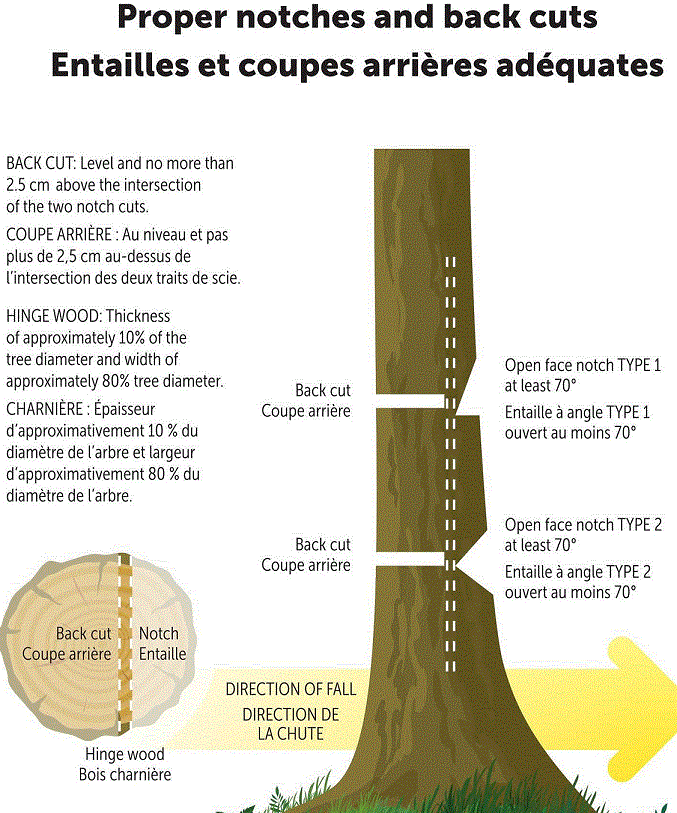
- (1.1) When felling a tree, an employee shall construct a hinge that will safely direct the tree to the ground by completing the following steps:
- (a) cut an open face notch of at least 70° where the cut meets clean and even with no by-pass and make a back cut that is level and no more than 2.5 cm above the intersection of the two notch cuts;
- (b) construct a uniform hinge that has a thickness of approximately 10% of the tree’s diameter and a width that is approximately 80% of the tree’s diameter; and
- (c) follow the instructions referred to in paragraphs (a) and (b) as illustrated below:
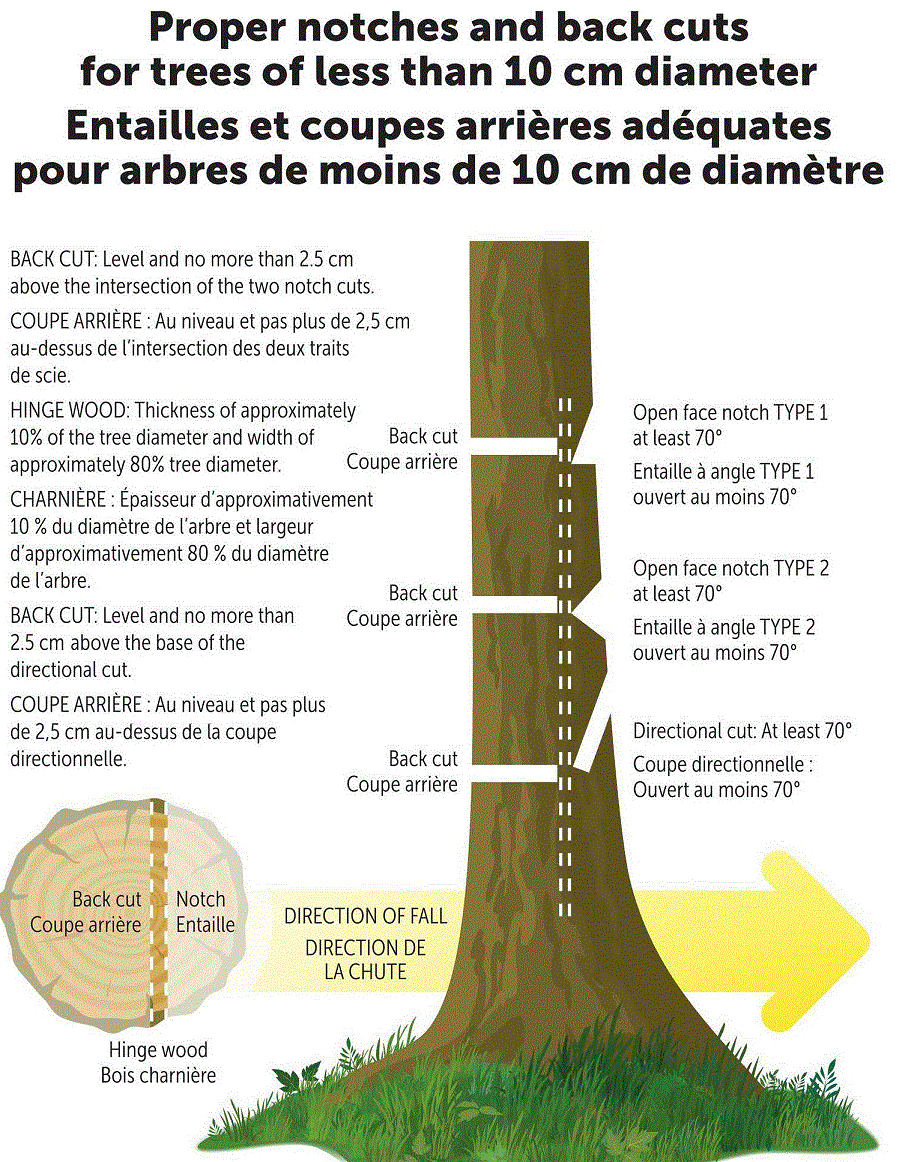
- (1.2) When felling a tree that is less than 10 cm in diameter, an employee shall construct a hinge by using the technique set out in subsection (1.1) or by completing the following steps:
- (a) make a directional cut of at least 70°;
- (b) make a back cut that is level and no more than 2.5 cm above the base of the directional cut;
- (c) leave a hinge that has a thickness of approximately 10% of the tree’s diameter and a width that is approximately 80% of the tree’s diameter; and
- (d) follow the instructions referred to in paragraphs (a) to (c) as illustrated below:
- (2) When felling a tree, an employee shall
- (a) Repealed. [N.B. Reg. 2022-27, s. 58]
- (b) use a felling lever or wedge as required;
- (c) complete the felling once it has been started; and
- (d) subject to subsection (2.1), as soon as the tree begins to fall, move at least 3 m away from the tree at a 45° angle from the direction opposite to the planned direction of fall.
- (2.1) When felling a tree on a slope greater than 30%, an employee may use an escape route that is perpendicular to the slope and not in the direction of the fall.
- (3) Where an employee fells a tree and the tree becomes lodged, the employee shall
- (a) stay in the area until the lodged tree is removed or if it is necessary to leave the area to obtain help to remove the tree, clearly mark as hazardous the area comprising a minimum radius of two tree lengths from the stump of the lodged tree
- (b) ensure that the lodged tree is removed as soon as the circumstances permit by operating a powered mobile equipment without being climbed by any person, having another tree felled on it or having the supporting tree cut, and
- (c) not do any work, other than removing the lodged tree, within the area referred to in paragraph (a).
- (4) An employee shall not cut a spring pole in a manner that will endanger any person.
[N.B. Reg. 2001-33, s. 116; 2022-27, s. 58]
Part XXII ARBORICULTURAL OPERATIONS
Section 369
369. Where tree removal or tree maintenance makes it necessary for an employee or for any object to approach closer to an energized electrical utility line or utility line equipment than the distances specified in subsection 289(1), an employee may undertake the tree removal or tree maintenance only if the employee has participated in and successfully completed a course in arboricultural electrical safety offered by the NB Safety Council Inc. or a course offered by another organization that is equivalent in content.
[N.B. Reg. 2005-20, s. 1]
Section 370
370. An employer shall notify the authority owning or operating an energized electrical utility line or utility line equipment of the intention to work closer to the electrical utility line or utility equipment than the distances specified in subsection 289(1), the location of the planned work and the time and duration of the planned work before any such work is done.
Section 371
- 371. (1) An employee who works closer to an energized electrical utility line or utility line equipment than the distances specified in subsection 289(1) shall not approach, or allow any object to approach, any energized electrical utility line or utility line equipment closer than the distances specified in the following table:
| Voltage Phase to Phase | Employee or Uninsulated Object | Insulated Object |
| Up to 750 v | 600 mm | 150 mm |
| 750 v - 15 kV | 900 mm | 300 mm |
| 16 kV- 25 kV | 1.2 m | 450 mm |
| 26 kV - 69 kV | 1.5 m | 900 mm |
| 70 kV - 138 kV | 1.8 m | 1.2 m |
| 139 kV - 230 kV | 2.1 m | 1.5 m |
| 231 kV - 345 kV | 3.7 m | 3.0 m |
- (2) An employee who works closer to an energized electrical utility line or utility line equipment than the distances specified in subsection 289(1)
- (a) shall not climb or cut a tree where any portion of the tree is closer to an energized electrical utility line or utility line equipment than the distances specified in the following table, and
- (b) shall ensure that no portion of a tree that is being cut, trimmed or maintained approaches any energized electrical utility line or utility line equipment closer than the distances specified in the following table:
| Voltage Phase to Phase | Where Employee is Using an Uninsulated Object | Where Employee is Using an Insulated Object without an Insulated Aerial Device | Where Employee is Using an Insulated Object with an Insulated Aerial Device |
| Up to 750 v | 300 mm | Up to but not touching | Up to but not touching |
| 750v - 15kV | 600 mm | 300 mm | Up to but not touching |
| 16kV - 25kV | 750 mm | 450 mm | Up to but not touching |
| 26kV - 69kV | 1.5 m | 1.0 m | 750 mm |
| 70kV - 138kV | 1.8 m | 1.2 m | 900 mm |
| 139kV - 230kV | 2.1 m | 1.8 m | 1.5 m |
| 231kV - 345kV | 3.7 m | 3.4 m | 3.0 m |
- (3) An employer shall ensure that an employee who is permitted to work closer to an energized electrical utility line or utility line equipment than the distances specified in subsection 289(1) does not work closer to the electrical utility line or utility line equipment than the distances specified in subsections (1) and (2).
- (4) Where an employee referred to in subsection (1) or (2) is about to commence work that may bring any person or object closer to an energized electrical utility line or utility line equipment than the distances specified in subsection (1) or (2), an employer shall contact the authority owning or operating the electrical utility line or utility line equipment and shall ensure that the electrical utility line or utility line equipment
- (a) is de-energized, or
- (b) is adequately insulated or guarded
- before permitting the employee to commence the work.
Section 372
- 372. (1) An employer shall ensure that an employee who works closer to an energized electrical utility line or utility line equipment than the distances specified in subsection 289(1) uses the protective equipment referred to in section 288.
- (2) An employee who works closer to an energized electrical utility line or utility line equipment than the distances specified in subsection 289(1) shall use the protective equipment referred to in section 288.
Section 373
373. An employee shall, before felling a tree or part of a tree, take necessary precautions for the safety of persons in the felling area.
Section 374
374. An employer shall ensure that an employee working more than 3 m above the nearest safe level uses a fall-arresting system or
- (a) wears a safety belt, a tree-trimming saddle belt or a saddle formed by a double bowline on a bight, and
- (b) uses as a life line, a rope designed for use in tree maintenance operations that is
- (i) inspected by the employee before each use,
- (ii) properly knotted when in use, and
- (iii) stored in a separate protective container.
[N.B. Reg. 2010-159, s. 45]